


Role of Indoor Plants in Enhancing Productivity
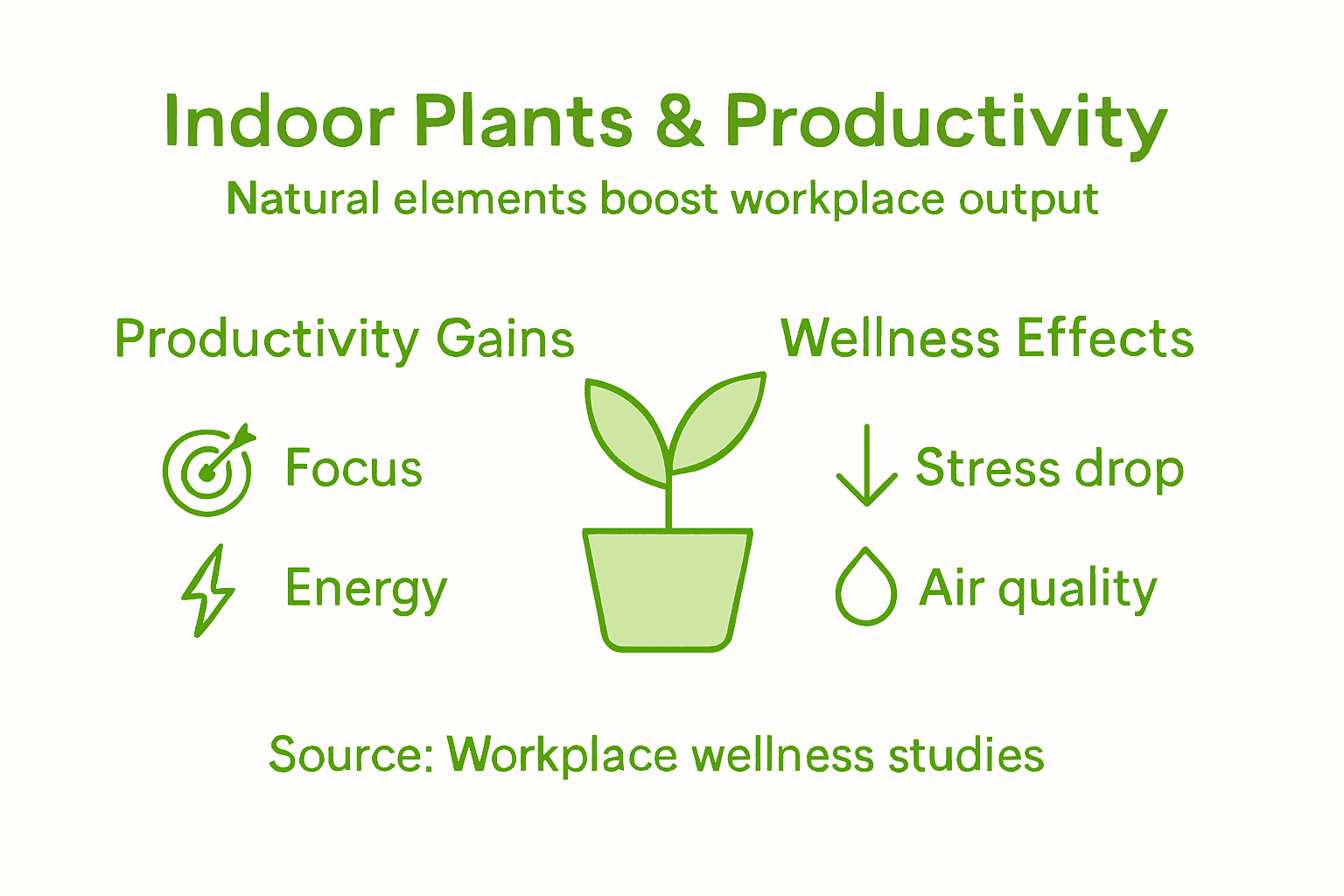
Busy offices across Greater Des Moines often feel disconnected from nature, leaving teams searching for ways to spark fresh energy and increase well-being. The integration of indoor plants in productive spaces is gaining recognition for more than just visual interest. Interior designers and workplace managers now value these living systems for their ability to improve air quality, reduce stress, and support employee health through biophilic design. This article uncovers how strategic plant choices can help reshape work environments for better focus and satisfaction.
Table of Contents
- Defining Indoor Plants In Productive Spaces
- Types Of Indoor Plant Installations For Workplaces
- How Plants Improve Cognitive Function And Air Quality
- Impact Of Biophilic Design On Employee Wellness
- Common Pitfalls In Office Plant Integration
Key Takeaways
| Point | Details |
|---|---|
| Indoor Plants Enhance Workspaces | They improve air quality, reduce stress, and enhance cognitive function, making them vital for employee well-being. |
| Diverse Plant Installations Offer Unique Benefits | From potted plants to green walls, each installation serves specific functions that can improve workspace quality. |
| Biophilic Design Supports Employee Wellness | Integrating natural elements fosters psychological health, enhances job satisfaction, and reduces burnout rates. |
| Strategic Implementation is Crucial | Successful plant integration requires careful planning around species selection, maintenance, and employee preferences. |
Defining Indoor Plants in Productive Spaces
Indoor plants are strategic design elements that transform workspaces beyond mere decoration. Holistic environmental connections reveal these green companions as powerful productivity enhancers with multifaceted benefits.
In professional environments, indoor plants represent more than aesthetic additions. They serve as living systems that actively contribute to workspace functionality and employee well-being. Key characteristics that define indoor plants in productive spaces include:
- Air Purification: Natural filtration of indoor pollutants
- Stress Reduction: Psychological calming effects
- Acoustic Moderation: Sound absorption capabilities
- Visual Engagement: Introducing organic design elements
- Humidity Regulation: Maintaining optimal environmental moisture
These plants are carefully selected based on specific workplace requirements, considering factors like lighting conditions, maintenance needs, and spatial dynamics. Commercial environments demand strategic plant selection that balances visual appeal with practical functionality.
The scientific understanding of indoor plants has evolved significantly, recognizing them as active workspace participants rather than passive decorative elements. Modern design approaches view these green installations as integrated environmental technologies that enhance human performance and workplace quality.
Pro tip: Select low-maintenance, adaptable plants like snake plants or pothos for consistent workplace performance and minimal upkeep requirements.
Types of Indoor Plant Installations for Workplaces
Workplace plant installations represent sophisticated strategies for enhancing environmental quality and employee well-being. Innovative biophilic design approaches have transformed how organizations integrate green elements into professional spaces.
Multiple types of indoor plant installations offer unique benefits for workplace environments. These strategic green solutions include:
- Potted Plants: Flexible, movable individual plant placements
- Green Walls: Vertical living installations covering entire wall surfaces
- Living Partitions: Natural dividers that create spatial separation
- Desktop Planters: Small-scale installations for personal workspaces
- Hanging Plant Systems: Suspended botanical arrangements maximizing vertical space
Each installation type serves distinct functional purposes beyond aesthetic appeal. Sustainable facility ecology demonstrates how these green systems contribute to indoor air quality, noise reduction, and psychological comfort.
Commercial environments increasingly recognize these plant installations as strategic investments in workplace performance. Modern design approaches integrate botanical elements not just as decorative features, but as active environmental technologies that directly influence human productivity and well-being.
Here’s a summary of how different types of workplace plant installations contribute to office environments:
| Installation Type | Ideal Space Use | Main Benefit Provided | Notable Challenge |
|---|---|---|---|
| Potted Plants | Individual offices, corners | Air quality improvement | Regular watering needed |
| Green Walls | Open lobbies, meeting rooms | Noise reduction, statement | Higher upfront installation |
| Living Partitions | Open-plan desks, corridors | Privacy, spatial division | Ongoing trimming requires care |
| Desktop Planters | Personal workstations | Mental focus support | Limited impact in large areas |
| Hanging Plant Systems | Ceilings, atriums | Maximizes vertical space | May require structural review |
Pro tip: Consult professional plant design experts to match specific plant installations with your workplace’s unique architectural and environmental characteristics.
How Plants Improve Cognitive Function and Air Quality
Cognitive performance benefits from indoor plants extend far beyond simple aesthetic improvements. Scientific research reveals that green environments can dramatically enhance mental functioning and physiological well-being in workplace settings.
Indoor plants contribute to cognitive enhancement through multiple interconnected mechanisms:
- Air Purification: Removal of volatile organic compounds
- Stress Reduction: Lowering psychological and physiological stress indicators
- Oxygen Enhancement: Improving indoor oxygen concentration
- Psychological Restoration: Creating calming visual environments
- Attention Restoration: Supporting mental focus and concentration
Enhanced workplace ventilation strategies demonstrate significant improvements in critical cognitive domains. Research indicates that green environments can boost decision-making capabilities, enhance working memory performance, and increase overall cognitive scores.

The intricate relationship between plants, air quality, and cognitive function represents a sophisticated biological interaction. Plants act as natural air purifiers, simultaneously removing environmental toxins while creating psychologically supportive spaces that promote mental clarity and emotional balance.
Pro tip: Position plants strategically near workstations to maximize air-purifying benefits and create micro-environments that support cognitive performance.
Impact of Biophilic Design on Employee Wellness
Nature-based workplace design strategies offer profound insights into employee health and organizational performance. Biophilic design represents a holistic approach to creating work environments that fundamentally support human physiological and psychological well-being.
Key dimensions of biophilic design that impact employee wellness include:
- Visual Connection: Integrating natural views and plant elements
- Sensory Engagement: Creating multi-sensory environmental experiences
- Stress Mitigation: Reducing psychological tension through natural elements
- Cognitive Restoration: Supporting mental clarity and focus
- Emotional Resilience: Promoting positive psychological states
Systematic reviews of workplace wellness interventions demonstrate significant correlations between natural design elements and improved employee motivation. Research indicates that strategic incorporation of biophilic principles can enhance job satisfaction, reduce workplace stress, and create more supportive organizational environments.
Biophilic design transcends traditional aesthetic considerations, emerging as a sophisticated approach to workplace wellness. By recognizing human beings’ intrinsic connection to natural systems, organizations can create environments that simultaneously support physiological health, psychological balance, and professional performance.
To clarify the impact, here’s how key biophilic design dimensions affect workplace outcomes:
| Biophilic Dimension | Direct Workplace Effect | Long-Term Benefit |
|---|---|---|
| Visual Connection | Enhances mood and focus | Higher employee satisfaction |
| Sensory Engagement | Reduces distractions | Promotes emotional resilience |
| Stress Mitigation | Calms stressful environments | Reduces burnout rates |
| Cognitive Restoration | Restores mental clarity | Improves job performance |
Pro tip: Conduct a comprehensive workplace assessment to identify specific biophilic design opportunities that align with your organization’s unique spatial characteristics and employee needs.
Common Pitfalls in Office Plant Integration
Plant integration challenges in workspaces reveal complex considerations beyond simple aesthetic placement. Organizations frequently underestimate the strategic planning required for successful indoor plant programs.
Common mistakes in office plant integration include:
- Inappropriate Species Selection: Choosing plants incompatible with office conditions
- Inconsistent Maintenance: Neglecting regular plant care and upkeep
- Overlooking Light Requirements: Placing plants in unsuitable lighting environments
- Ignoring User Preferences: Implementing plant designs without employee input
- Poor Spatial Planning: Crowding or randomly distributing plant installations
Successful plant integration demands a nuanced understanding of environmental conditions, employee interactions, and organizational design principles. Each plant installation represents a living system requiring careful consideration of light exposure, humidity, temperature, and maintenance protocols.
Professional plant programs must move beyond decorative approaches, viewing indoor vegetation as dynamic environmental technologies that actively contribute to workspace functionality. This requires comprehensive assessment of spatial characteristics, employee workflows, and long-term sustainability strategies.
Pro tip: Develop a comprehensive plant management protocol that includes regular maintenance schedules, species-specific care guidelines, and periodic employee feedback mechanisms.
Transform Your Workspace With Purposeful Indoor Plant Design
The article highlights the challenges many workplaces face when integrating indoor plants such as selecting the right species, maintaining air quality, and enhancing cognitive function while supporting employee wellness. If you want to avoid common pitfalls like inconsistent maintenance and mismatched plant choices, Trendy Gardener offers expert solutions tailored to elevate your environment through strategic biophilic design. Our living walls, green partitions, and desktop plant styling are designed with precision to improve air purification, reduce stress, and uplift productivity.
Bring these natural benefits into your workspace today and discover how thoughtfully placed plants can transform employee wellness and focus. Visit Trendy Gardener to explore our complete plant programs including consultation, installation, and ongoing care. Take the first step toward a healthier, more vibrant office by connecting with our expert team for a personalized plant solution built to last.
Frequently Asked Questions
What benefits do indoor plants provide in a workplace?
Indoor plants offer several benefits in a workplace, including air purification, stress reduction, noise absorption, visual engagement, and humidity regulation, all of which contribute to a healthier and more productive environment.
How do indoor plants impact employee cognitive function?
Indoor plants enhance cognitive function by improving air quality, reducing stress, and creating calming environments. This leads to increased focus, better decision-making, and improved overall cognitive performance.
What are some effective types of indoor plant installations for offices?
Effective types of indoor plant installations include potted plants, green walls, living partitions, desktop planters, and hanging plant systems. Each type serves unique purposes such as enhancing aesthetics, providing privacy, or improving air quality.
What common mistakes should be avoided when integrating plants into office spaces?
Common mistakes include selecting inappropriate plant species, inconsistent maintenance, ignoring light requirements, overlooking employee preferences, and poor spatial planning. Careful consideration of these factors is crucial for successful plant integration.