


Role of Plants in Commercial Spaces: Real Impact
Many office managers in Greater Des Moines have found that plants do much more than brighten up a lobby or conference room. For commercial real estate leaders and architects, the real value comes from creating spaces where employees feel healthier and work more efficiently. Research shows that plants improve indoor climate, increase workspace satisfaction, and reduce employee health complaints, making biophilic solutions a strategic investment rather than a decorative choice.
Table of Contents
- Defining The Role Of Plants In Workplaces
- Key Benefits For Employee Wellness And Branding
- Popular Plant Types And Biophilic Design Features
- Installation, Leasing, And Maintenance Essentials
- Financial And Sustainability Implications For Owners
Key Takeaways
| Point | Details |
|---|---|
| Plants Enhance Workplace Performance | Integrating plants in commercial spaces can lead to improved air quality, employee morale, and reduced health complaints, thus increasing overall productivity. |
| Strategic Plant Placement is Key | Effective biophilic design requires careful planning, including site assessments to ensure proper light and humidity for plant health. |
| Professional Maintenance is Essential | Ongoing care by specialized plantscaping partners ensures that plant installations remain visually appealing and continue to deliver health benefits over time. |
| Biophilic Design is a Competitive Advantage | Properties with integrated greenery command higher rental premiums and attract quality tenants looking for sustainable office environments. |
Defining the Role of Plants in Workplaces
Plants in commercial spaces aren’t decorative afterthoughts. They’re functional elements that measurably impact how buildings perform and how people thrive inside them. For commercial real estate managers and architects in Greater Des Moines, understanding this role means designing workplaces that actually deliver results. When you integrate plants strategically, you’re not just making spaces look better—you’re creating environments where employees experience fewer health complaints, feel greater privacy, and maintain higher engagement levels.
The science is clear: incorporating plants into office environments delivers measurable improvements across several dimensions. These benefits include:
- Improved physical indoor climate: Plants regulate humidity and air quality, reducing complaints about dry air that plague many commercial spaces
- Enhanced workspace perception: Employees report greater satisfaction with their environment when greenery is present
- Reduced health complaints: Better air quality and perceived privacy translate to fewer sick days and health-related absences
- Stronger sense of privacy: Visual screening through plants helps create psychological boundaries in open office layouts
- Elevated attractiveness: Spaces with natural elements simply feel more refined and intentional
These aren’t abstract benefits. In a competitive talent market where Des Moines companies compete for quality employees, workspace quality directly impacts recruitment and retention. A manager at a downtown Des Moines firm recently discovered that adding living walls to their open floor plan reduced employee complaints about noise and interruptions by roughly 40 percent within three months. That’s the kind of tangible outcome that justifies investment.
The Productivity and Morale Connection
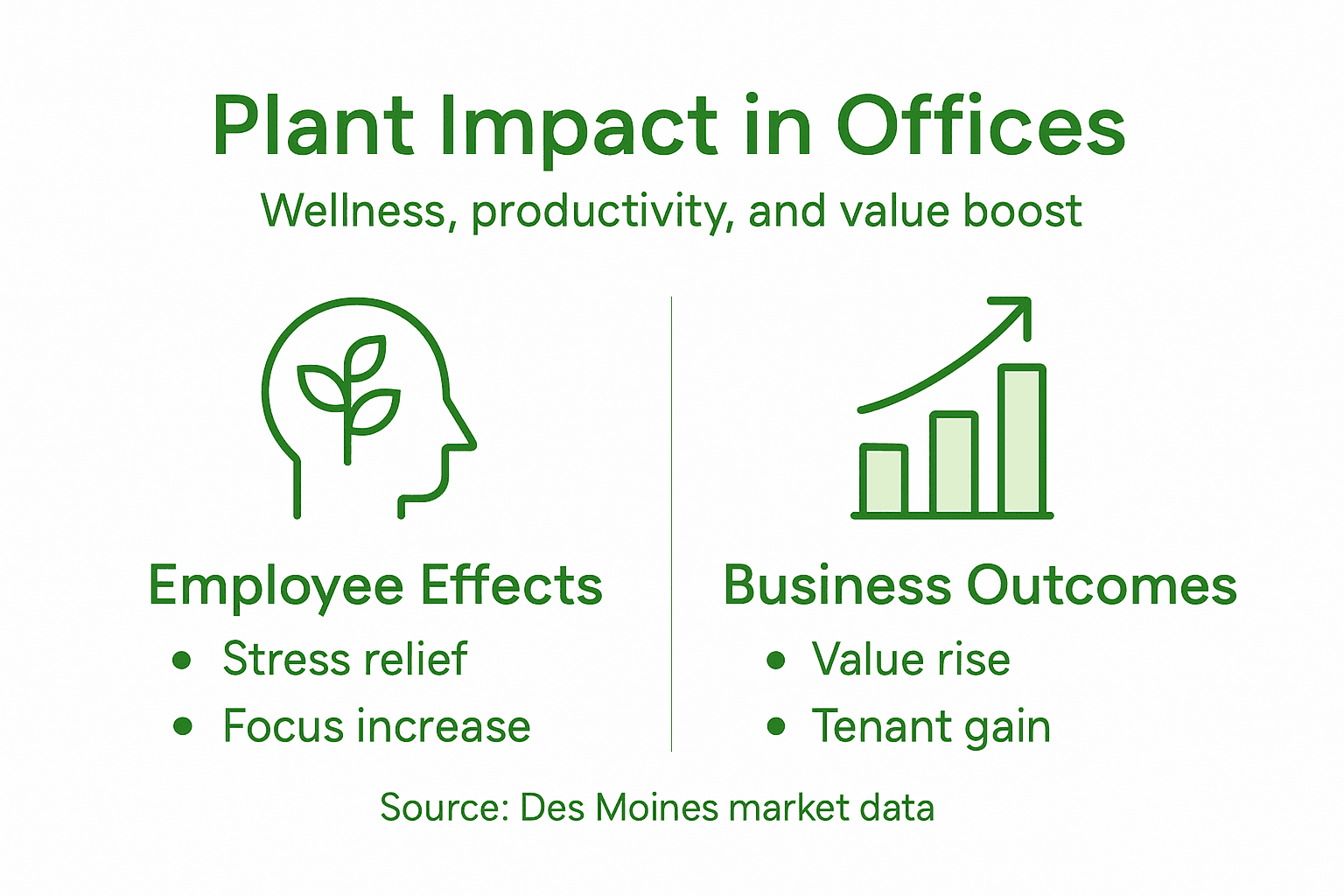
Beyond air quality and aesthetics, plants influence how people actually work. Research on natural elements in office settings shows that incorporating plants boosts morale, creativity, and overall employee performance. Even small-scale interventions matter. You don’t need an Amazon Spheres-level installation to see results. Strategic placement of biophilic elements—whether that’s a living wall in a conference room, a preserved moss wall in the reception area, or grouped planters in collaborative zones—creates what researchers call “micro-nature.”
The reason this works comes down to how our brains respond to natural elements. When employees have visual access to plants, their stress levels decrease, focus improves, and creative thinking flows more naturally. For architects designing commercial spaces in Iowa, this means considering plant integration as a fundamental design component, not an optional enhancement.
What makes this particularly relevant for Des Moines commercial spaces: many buildings here were designed in eras when biophilic design wasn’t a priority. You’re retrofitting older office buildings where HVAC systems, lighting design, and furniture layouts weren’t planned around plant integration. This requires strategic planning. You need to assess moisture levels, light availability, accessibility for maintenance, and spatial design before recommending specific plant solutions.
Plants transform commercial spaces from merely functional to genuinely restorative—which means people actually want to be there.
The role of plants extends beyond individual well-being to organizational performance. Workspaces with integrated greenery show improved team dynamics, increased helpfulness between colleagues, and stronger collaboration. For property managers tracking occupancy rates and tenant satisfaction, plant integration becomes a competitive advantage. When you’re marketing commercial space in a market like Greater Des Moines, mentioning professionally maintained biophilic design elements matters to forward-thinking companies.
Understood this way, plants are no longer nice-to-have additions. They’re strategic assets that influence occupancy decisions, employee productivity, and long-term tenant relationships. Whether you’re managing a 20,000-square-foot office building or designing a new commercial complex, the question isn’t whether to integrate plants—it’s how to integrate them effectively for your specific space and tenant needs.
Pro tip: Start your biophilic design planning by auditing light conditions and humidity levels throughout your commercial space, then consult with a specialized plantscaping partner to match plant solutions to actual environmental conditions rather than guessing at placement.
Key Benefits for Employee Wellness and Branding
When you walk into a commercial space filled with healthy plants, something shifts immediately. The air feels fresher. The energy feels different. That’s not just perception—it’s measurable reality. For commercial real estate managers and architects in Greater Des Moines competing for tenants and top talent, understanding how plants drive employee wellness and strengthen brand identity is the difference between a standard office building and one people actually want to work in.
Wellness Impact That Shows Up in Retention
The wellness benefits start at a physiological level. Office plants reduce stress and anxiety while improving air quality, creating calming environments that encourage mindfulness and sharper focus. Employees working in spaces with integrated greenery experience measurably lower cortisol levels, fewer stress-related absences, and better overall job satisfaction. For property managers in Iowa, this translates directly to tenant retention—companies stay longer when their employees are happier and healthier.
Beyond stress reduction, plants boost creativity and problem-solving capacity. When your brain isn’t exhausted fighting environmental stressors, cognitive resources shift toward innovation. A tech startup occupying 5,000 square feet in a Des Moines office park reported that after installing living walls in their collaboration zones, project completion timelines improved by approximately three weeks per quarter. That’s not anecdotal—that’s measurable business impact.
The wellness benefits break down into several clear categories:
- Stress and anxiety reduction: Visual connection to nature triggers parasympathetic nervous system activation, literally calming employees physiologically
- Improved air quality: Plants remove carbon dioxide and absorb toxins, reducing respiratory complaints
- Enhanced focus and creativity: Biophilic environments reduce cognitive load, freeing mental resources for complex thinking
- Better sleep quality: Employees exposed to natural light and greenery during work hours experience improved circadian rhythm regulation
- Reduced absenteeism: Lower stress and better overall health mean fewer sick days
- Improved team dynamics: Shared green spaces naturally encourage positive interactions and collaboration
Branding and Market Positioning
Here’s what most commercial property managers miss: plants are a branding statement. They signal intentionality. They communicate that your company or building cares about human experience, not just square footage and rent. For Greater Des Moines commercial real estate, where the market is increasingly competitive, biophilic design separates premium properties from commodity spaces.
When a financial services company or healthcare organization tours a potential office space and finds professionally designed living walls, preserved moss installations, and strategically placed planters, their perception shifts. This isn’t a generic industrial park. This is a space that values culture. That signal matters during lease negotiations, especially when recruiting and retaining specialized talent.
Brand alignment also works the other direction. If your company positions itself as modern, innovative, or employee-focused, then your physical space needs to reflect that. A company claiming to value wellness while occupying a beige box with plastic ficus trees creates cognitive dissonance. Authentic biophilic design closes that gap. It makes your brand promise visible and tangible.
When wellness becomes visible in your physical space, it becomes real in employee experience—and that authenticity attracts the right tenants and talent.
The financial case is straightforward. Companies occupying naturally designed spaces show improved productivity metrics, lower turnover costs, and stronger recruitment capacity. For a mid-size Des Moines firm with 80 employees experiencing 15 percent annual turnover, the cost of recruitment and training exceeds $180,000 annually. If improved workspace design cuts that to 10 percent turnover, the payback on plant design investment happens in months, not years.
Beyond numbers, there’s another factor: competitive differentiation. When you’re marketing commercial space in Iowa, mentioning bespoke living walls, custom preserved moss installations, and professional plant maintenance programs becomes a genuine competitive advantage. Forward-thinking companies understand that office environment directly impacts their ability to attract remote-first talent back into physical spaces. Plants signal that you’ve thought about human experience, not just square footage.
Pro tip: Document wellness and productivity improvements after plant installation through employee surveys or simple absenteeism tracking, then use that data in your marketing materials to demonstrate tangible ROI to prospective tenants.
Popular Plant Types and Biophilic Design Features
Not all plants work equally well in commercial spaces. The species you choose, how you position them, and what design framework you build around them determines whether your biophilic installation becomes a genuine asset or just expensive decoration. For commercial real estate managers and architects in Greater Des Moines, selecting the right plants means understanding both their practical requirements and their visual impact on tenant perception and employee experience.
Plant Selection for Commercial Environments
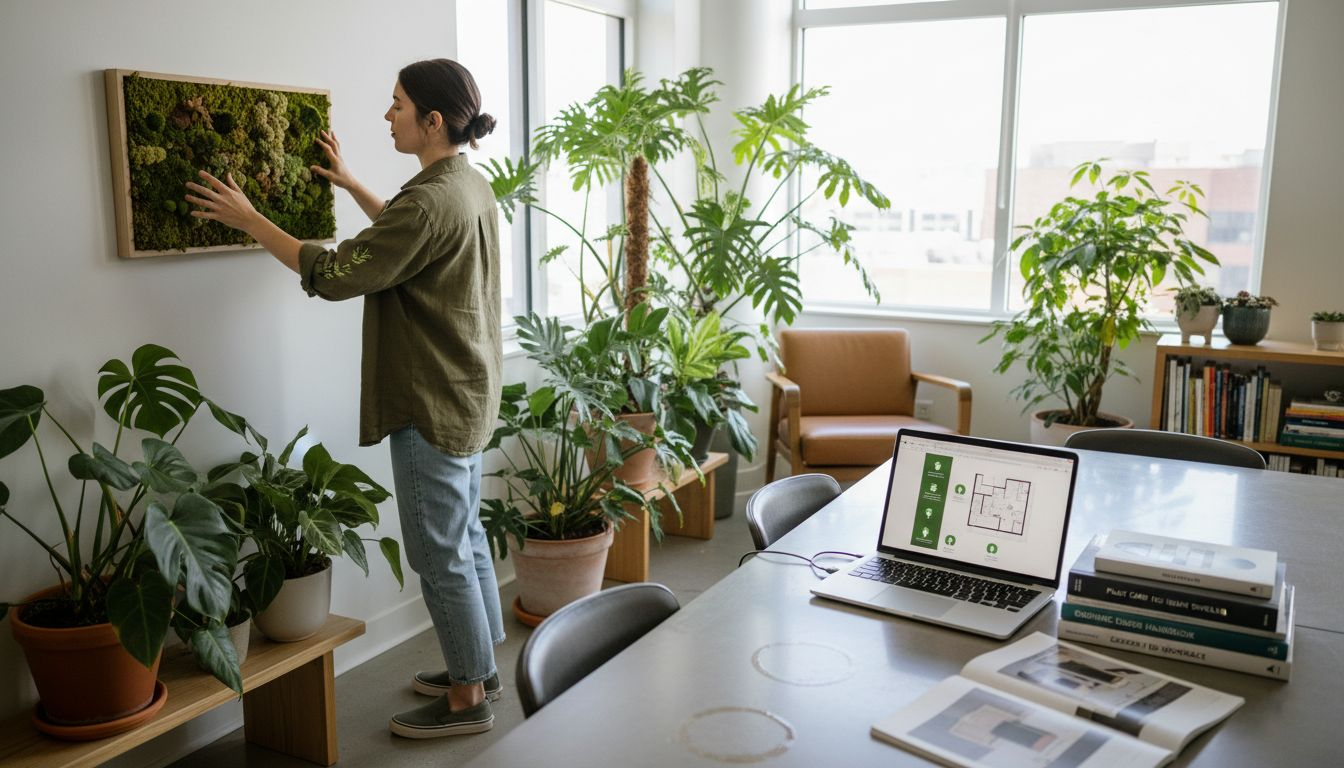
The most effective commercial plants share common characteristics: they tolerate variable light conditions, require minimal special maintenance, and deliver strong visual impact. Large leafy species and air-purifying plants enhance air quality and aesthetics in biophilic commercial designs, making them foundational choices for any professional installation.
Here are the plant categories that consistently perform in Des Moines commercial spaces:
- Large leafy specimens: Monsteras, Philodendrons, and Ficus varieties create visual presence and psychological impact through dramatic foliage
- Air-purifying powerhouses: Pothos, Snake plants, and Peace lilies actively remove toxins from indoor air while requiring minimal oversight
- Green walls and living installations: Vertical plantings that maximize visual impact in limited floor space while creating natural acoustic benefits
- Preserved moss elements: Low-maintenance alternatives that add texture and organic warmth without watering requirements
- Tropical foliage plants: Calathea and Dracaena varieties that tolerate office lighting and add visual sophistication
- Clustering options: Grouped smaller plants that create visual abundance without overwhelming individual spaces
The selection process requires understanding your specific building. A downtown Des Moines office with large north-facing windows demands different plant selections than a windowless conference room in a suburban business park. Moisture levels, HVAC systems, foot traffic patterns, and tenant aesthetic preferences all influence which species will actually thrive rather than decline.
Biophilic Design Framework and Implementation
Biophilic design goes beyond simply placing plants in corners. It’s a systematic approach to integrating natural elements throughout commercial space in ways that trigger psychological and physiological responses. The framework includes multiple integration methods working together.
Consider these key biophilic design features for commercial spaces:
- Living walls and green features: Vertical planted surfaces that transform blank walls into visual focal points while creating sound absorption and improving air quality simultaneously
- Natural light maximization: Positioning plantings near windows where they benefit from natural light and allow occupants visual access to circadian rhythm support
- Organic material integration: Combining plants with natural wood finishes, stone surfaces, and earth-tone palettes to create cohesive biophilic environments
- Water features and moisture: Incorporating visible moisture elements that trigger cognitive relaxation responses
- Visual connectivity: Arranging plantings so employees have regular sightlines to greenery rather than hiding plants in back corners
- Sensory engagement: Selecting plants with varied textures, fragrances, and visual interest to create multisensory experiences
The difference between casual plant placement and intentional biophilic design shows immediately. A reception area with three random potted plants reads as afterthought. A reception area with a strategically designed living wall, coordinated planter selections, and intentional lighting creates the impression of a company that genuinely understands environmental psychology.
Effective biophilic design feels inevitable, not added—as though the plants belong to the space rather than being inserted into it.
For Des Moines commercial properties competing in an increasingly design-conscious market, biophilic implementation becomes a tenant recruitment tool. When a company evaluates two comparable office buildings, the one with thoughtfully designed green elements creates measurably stronger lease interest.
Maintenance and Long-Term Success
Here’s where many commercial installations fail: they look exceptional on day one and decline within months due to inadequate maintenance planning. Professional biophilic design requires professional plant care. This isn’t a problem you solve with an office manager and a watering can.
Successful commercial plant programs include dedicated maintenance schedules addressing:
- Weekly watering and nutrient management
- Monthly foliage cleaning and disease monitoring
- Seasonal pruning and shape maintenance
- Immediate replacement of declining specimens
- Pest and disease prevention
- Environmental monitoring and adjustment
For commercial property managers in Iowa, partnering with a specialized plantscaping provider transforms plant installations from maintenance liabilities into competitive assets. The investment in professional care protects your initial design investment while ensuring the visual and wellness benefits persist long-term.
Pro tip: When selecting plant species for your commercial space, prioritize varieties that match your building’s actual light and humidity conditions rather than aspirational conditions, then commit to professional maintenance contracts that include regular monitoring and rapid issue response.
Installation, Leasing, and Maintenance Essentials
Getting plants into your commercial space is straightforward. Keeping them healthy, visually impressive, and aligned with your building’s operational realities is where most property managers struggle. For commercial real estate managers and architects in Greater Des Moines, understanding the practical mechanics of installation, the financial considerations of leasing versus ownership, and the ongoing maintenance requirements determines whether your biophilic investment becomes a strategic asset or an expensive problem.
Installation Strategy and Logistics
Successful plant installation requires planning that happens before the first plant arrives at your building. You’re not simply dropping pots in corners. You’re positioning living elements within a carefully designed ecosystem that accounts for structural requirements, environmental conditions, and operational workflows.
The installation process breaks down into these essential phases:
- Site assessment and environmental analysis: Measuring light levels, humidity, temperature fluctuations, and HVAC patterns to match plant selections to actual conditions
- Structural and safety considerations: Ensuring walls can support living wall installations, that water systems won’t damage flooring or electrical systems, and that plantings won’t obstruct emergency exits
- Moisture and water management: Installing proper drainage, protecting adjacent surfaces, and planning water delivery systems that integrate with building maintenance
- Electrical and lighting evaluation: Assessing whether grow lights are necessary and how to integrate them without creating visual clutter
- Phased installation timeline: Bringing plantings in stages to allow HVAC and environmental systems to stabilize rather than overwhelming building systems simultaneously
- Professional installation and setup: Using specialists who understand both horticultural requirements and commercial building mechanics
A downtown Des Moines office building discovered that attempting to install a 400-square-foot living wall without proper drainage planning created moisture issues affecting the adjacent conference room. The project cost an additional $28,000 in remediation. That’s not a plant problem. That’s a planning problem. Professional installation partners prevent these scenarios through systematic assessment before installation begins.
Leasing Versus Ownership Models
Here’s where many commercial property managers make incorrect financial decisions: they treat plant acquisition like furniture purchase. It’s not. Understanding plant leasing versus buying approaches directly impacts your long-term financial outcomes and operational complexity.
Let’s break down the fundamental difference:
Ownership model means you purchase plants outright, assume responsibility for all maintenance, and manage replacement cycles. You control the capital investment upfront but absorb all operational costs. If a specialist plant dies, you absorb replacement expense. If maintenance gets inadequate, the visual decline reflects on your property.
Leasing model means you contract with a professional plantscaping partner who maintains ownership, handles all maintenance, monitors plant health, guarantees replacements, and provides design expertise as part of the service. You pay monthly fees but eliminate maintenance management, staff training, and replacement risk.
For most commercial property managers, leasing delivers superior outcomes:
- Predictable monthly costs with no surprise replacement expenses
- Professional accountability through service level agreements
- Operational simplicity with no internal maintenance staff requirements
- Design continuity as your partner proactively adjusts plantings based on changing building conditions
- Rapid issue response when problems emerge
- Seasonal adjustments to maximize visual impact year-round
- Risk transfer with guaranteed replacements if plants decline
Consider a 50,000-square-foot commercial building with integrated biophilic design across three floors. Leasing costs approximately $3,500 monthly. Ownership would require hiring a dedicated part-time plant care specialist ($28,000 annually), purchasing replacement inventory ($5,000 annually), and managing potential liability when plantings deteriorate. The math strongly favors leasing for property managers.
Here’s how the ownership and leasing models for commercial plant installations compare:
| Aspect | Ownership Model | Leasing Model |
|---|---|---|
| Upfront Capital Required | High initial purchase cost | Low initial cost, monthly fees |
| Maintenance Responsibility | Handled internally or by vendor | Fully managed by provider |
| Plant Replacement Cost | Paid by owner for each instance | Included in leasing fees |
| Flexibility & Upgrades | Limited unless repurchased | Frequent updates allowed |
| Budget Predictability | Costs vary with issues | Consistent, predictable expenses |
| Performance Guarantee | Rarely included | Guaranteed by contract |
Professional plant leasing transfers maintenance complexity to specialists while guaranteeing the visual and wellness benefits persist long-term.
Ongoing Maintenance and Performance Standards
Regardless of whether you lease or own, successful biophilic installations require consistent, professional care. This isn’t hobby gardening. This is commercial-scale horticultural management with specific performance standards.
Essential maintenance components include:
- Weekly monitoring and care: Watering schedules adjusted for seasonal conditions, foliage inspection, and early pest detection
- Biweekly detailed maintenance: Foliage cleaning to maximize photosynthesis and visual appeal, checking drainage systems, and adjusting lighting
- Monthly health assessment: Evaluating overall plant vigor, addressing nutrient deficiencies, pruning dead growth, and identifying declining specimens
- Quarterly environmental review: Testing moisture levels, light intensity, and temperature stability to ensure conditions remain optimal
- Seasonal adjustments: Modifying watering frequency, adjusting grow lights, and replacing seasonal plantings for visual impact
- Documentation and reporting: Providing property managers with maintenance records and performance metrics
For Greater Des Moines commercial properties, the difference between adequate and excellent maintenance becomes visible within months. Well-maintained installations create stronger tenant satisfaction, improved recruitment outcomes, and higher lease renewal rates. Neglected installations become visual liabilities that undermine your property’s competitive position.
Partner selection matters enormously. You want a provider with specific commercial experience, documented service standards, responsive communication protocols, and a track record in your region. Generic landscaping companies often lack the specialized knowledge required for professional interior plantscaping.
Pro tip: Establish a formal service level agreement with your maintenance partner that specifies response times for plant replacements, maintenance schedules, and documentation requirements, then track performance metrics quarterly to ensure accountability.
Financial and Sustainability Implications for Owners
Plant integration in commercial spaces isn’t a lifestyle choice. It’s a financial decision with measurable impacts on property valuation, tenant acquisition, operating costs, and long-term market competitiveness. For commercial real estate managers and architects in Greater Des Moines, understanding the financial mechanics of biophilic design means recognizing that sustainable building practices increasingly determine property value and tenant demand.
Rental Premiums and Tenant Attraction
Here’s what property owners in Iowa often overlook: tenants will pay premium rent for well-designed commercial spaces that support employee wellness and align with corporate sustainability commitments. Sustainable commercial building investments enjoy higher rental premiums and improved tenant satisfaction, positioning biophilic design as a value-creation tool rather than a cost center.
The premium is real and quantifiable. Commercial properties in competitive markets with documented biophilic design features command 3 to 5 percent rental premiums compared to functionally equivalent buildings without integration. For a 50,000-square-foot office building leasing at $18 per square foot, that’s an additional $45,000 to $75,000 annually in rental income. Over a 10-year lease cycle, you’re generating $450,000 to $750,000 in additional revenue from design choices that cost $80,000 to $150,000 to implement.
More importantly, properties with professional plant installations and biophilic design experience demonstrably faster lease-up cycles and higher renewal rates. A Des Moines commercial building that reduced vacancy periods from 6 months to 2.5 months through tenant attraction benefits alone justified its entire biophilic investment in the first year. That’s not sustainability marketing. That’s financial impact.
Tenant companies increasingly view workspace design as a talent recruitment and retention tool. Technology firms, professional services companies, and healthcare organizations specifically seek offices with natural elements because they understand the wellness science. When your property offers documented biophilic design, you attract tenants who stay longer, expand their footprint within your building, and recommend your property to other quality companies.
Operating Costs and Energy Efficiency
Plants influence building operating costs in ways many property managers don’t fully consider. Living walls and strategic plantings improve thermal regulation by creating insulation layers, reducing solar heat gain through strategic shading, and moderating interior temperature fluctuations. The impact varies by building orientation and climate, but professional biophilic installations typically reduce HVAC demand by 2 to 8 percent depending on implementation.
For a 50,000-square-foot building spending $120,000 annually on HVAC costs, even a 3 percent reduction generates $3,600 in annual savings. Over 20 years, that’s $72,000 in cost reduction before accounting for inflation. Meanwhile, plants actively improve indoor air quality, reducing the demand on HVAC filtration systems and extending equipment life.
The financial benefits extend beyond energy efficiency:
- Reduced maintenance costs: Properly maintained biophilic installations actually extend building component lifespan by protecting surfaces from direct sunlight damage
- Improved air quality: Active plant integration reduces reliance on expensive high-efficiency filtration systems
- Humidity regulation: Plants naturally regulate interior moisture levels, reducing dehumidification costs in humid seasons
- Acoustic benefits: Living walls absorb sound, reducing noise complaints and improving tenant satisfaction without expensive acoustic retrofitting
- Aesthetic durability: Well-maintained plantings look substantially better than painted surfaces over time, reducing cosmetic refresh expenses
Regulatory and Risk Positioning
Environmental regulations tighten continuously. Property owners who position themselves ahead of regulatory curves avoid costly retrofitting later. Sustainable building strategies address tightening environmental regulations while meeting increasing tenant demand for green spaces, meaning biophilic integration becomes regulatory positioning rather than optional enhancement.
Greater Des Moines building codes increasingly emphasize indoor environmental quality. Properties documented as sustainable investments enjoy regulatory advantage, easier permitting for future modifications, and reduced liability exposure. More significantly, institutional investors and lending institutions increasingly require sustainability documentation for commercial property financing. Biophilic design becomes a financial asset when refinancing or attracting institutional capital.
Properties that integrate biophilic design strategically create measurable financial advantages while simultaneously reducing long-term regulatory and climate-related risks.
Climate-related risks also matter. Properties with green infrastructure demonstrate resilience to extreme weather events, manage stormwater through planted elements, and mitigate urban heat island effects. These aren’t abstract sustainability benefits. They’re concrete risk reduction factors that influence insurance costs, financing terms, and property valuation in markets increasingly shaped by climate considerations.
Valuation Impact and Long-Term Asset Position
Sustainable commercial properties command higher valuations. Properties documented as LEED-certified or featuring comprehensive biophilic design elements valuate at 5 to 10 percent premiums compared to equivalent buildings without sustainability integration. For a $25 million commercial property, that represents $1.25 to $2.5 million in additional asset value.
The valuation premium emerges from multiple factors working simultaneously: higher rental income, faster lease-up cycles, improved tenant retention, lower operating costs, reduced risk profile, and alignment with institutional investor preferences. When you aggregate these factors, biophilic design transforms from a nice-to-have amenity into a value-creation strategy.
For property owners in Greater Des Moines considering major capital investments, the financial case increasingly favors biophilic integration. The upfront design and installation costs typically represent 2 to 4 percent of total building renovation budgets, while the financial returns—through rental premiums, operational savings, faster leasing, and valuation appreciation—generate 300 to 500 percent return on investment over 10 years.
The following table summarizes the main financial impacts of biophilic design in commercial spaces:
| Financial Area | Impact Description | Typical Outcome |
|---|---|---|
| Rental Premiums | Higher lease rates with design features | 3%–5% increase annually |
| Operating Costs | Reduced HVAC and maintenance expenses | 2%–8% cost savings |
| Occupancy Timelines | Faster tenant acquisition and renewals | Up to 60% shorter vacancy |
| Property Valuation | Increases in market asset value | 5%–10% higher appraisal |
| Turnover & Training | Lower tenant and staff replacement cost | Savings over multi-years |
Pro tip: Document your biophilic design specifications, maintenance protocols, and tenant satisfaction metrics, then use this data when communicating with potential investors, lenders, or prospective tenants to demonstrate the financial value of your sustainability strategy.
Transform Your Commercial Space With Strategic Plant Integration
The article highlights the crucial role plants play in enhancing workplace wellness and boosting tenant satisfaction through intentional biophilic design. If you are grappling with challenges like maintaining employee health, improving workspace aesthetics, and increasing property value, you are not alone. Key goals such as optimizing air quality, creating privacy, and reducing absenteeism are exactly where expert plantscaping can deliver measurable results. At Trendy Gardener, we understand that plant installations must be thoughtfully planned to thrive long term and elevate your commercial environment strategically.
Our comprehensive approach includes bespoke living walls, custom preserved moss walls, and tailored plant leasing solutions designed specifically for commercial scale. We partner with you from consultation through installation to provide continued maintenance so your spaces continue to impress and perform. Explore how our office plant design and indoor plant maintenance services respond directly to challenges outlined in the article by creating environments where employees feel healthier, more focused, and truly engaged.
Boost tenant attraction and retention now with proven biophilic solutions that support productivity and wellness.
Experience the difference professional plant integration makes by partnering with Trendy Gardener. Visit Trendy Gardener to start your customized plant program today and turn your commercial space into a restorative and inviting environment.
Frequently Asked Questions
How do plants improve the indoor climate in commercial spaces?
Plants help regulate humidity and enhance air quality, reducing complaints related to dry air in office environments.
What psychological benefits do plants provide to employees in commercial settings?
Plants have been shown to reduce stress, improve focus, and stimulate creativity, creating a more engaging and productive workplace atmosphere.
What types of plants are best suited for commercial office environments?
Effective commercial plants include large leafy varieties such as Monsteras and Philodendrons, as well as air-purifying options like Pothos and Peace lilies, which tolerate variable light and require minimal maintenance.
How can businesses measure the impact of plants on employee wellness and productivity?
Businesses can track wellness improvements through employee surveys, measuring productivity metrics, and monitoring absenteeism rates before and after plant integration.
Recommended
- Commercial Plantscaping: Boosting Workplace Well-Being
- Choosing the Right Commercial Plants for Your Business
- Choosing the Right Commercial Plants for Your Business
- Incorporating Green Interior Design into Commercial Spaces: A Guide
- What is Housekeeping? Understanding Its Importance and Role | Rozie - Malta’s Best Cleaning Services